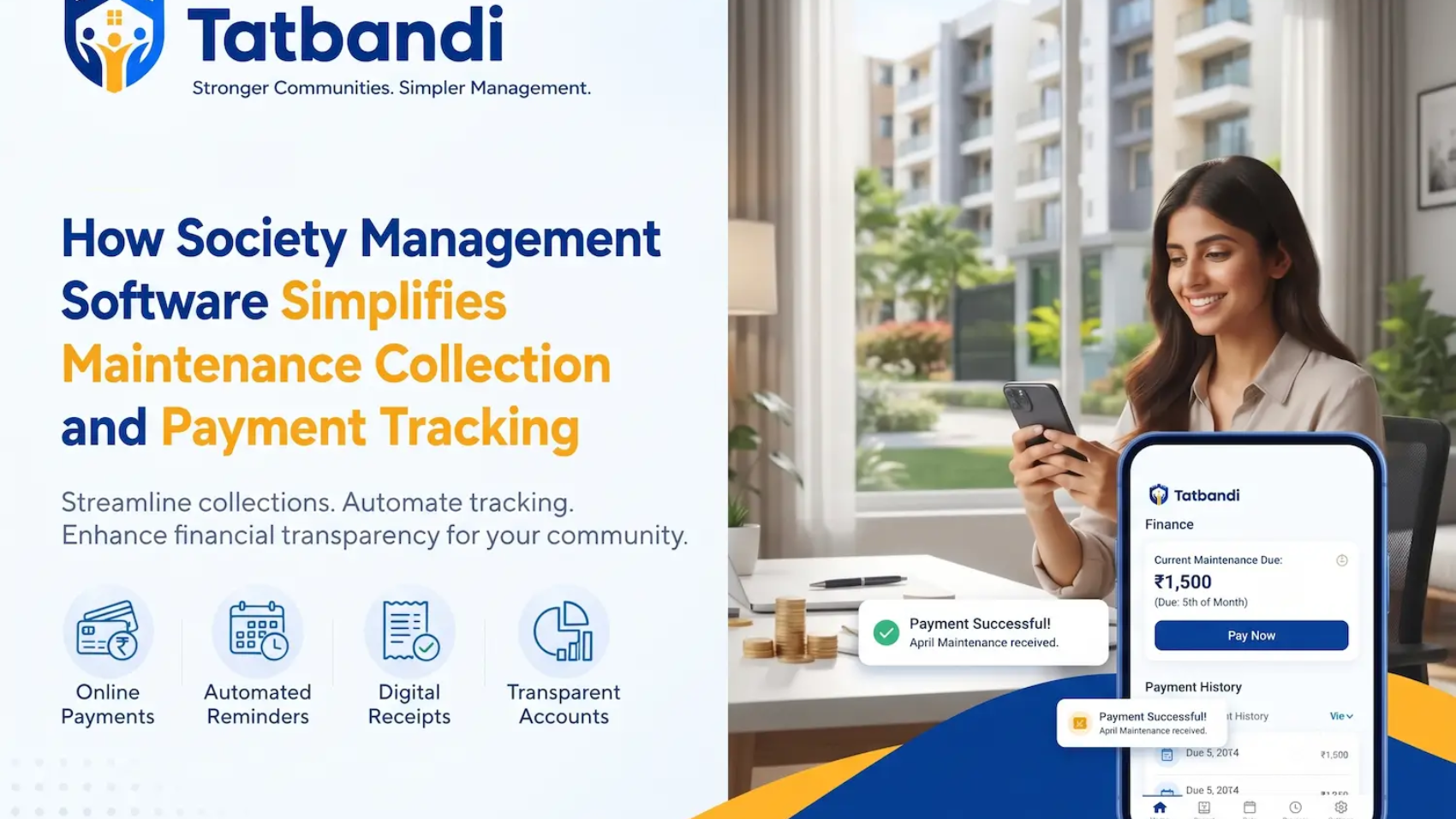
How Society Management Software Simplifies Maintenance Collection and Payment Tracking

How Society Management Software Simplifies Maintenance Collection and Payment Tracking

Managing monthly maintenance is one of the most important responsibilities of a housing society committee. Every month, committee members need to generate maintenance bills, communicate dues to residents, track payments, follow up on outstanding amounts, maintain records, and prepare financial information.

When these activities are handled manually through spreadsheets, paper receipts, bank statements, and messaging applications, the process can become time-consuming and difficult to monitor.

This is where society management software can make a significant difference.

A digital platform such as Tatbandi helps housing societies organize maintenance billing and payment tracking while bringing resident information, expenses, notices, complaints, parking, and other community-management activities into one platform.

The goal is simple: make society maintenance management more organized, transparent, and convenient.


What Is Society Maintenance Management?

Society maintenance management involves the processes used by a housing society to collect and manage recurring maintenance contributions from residents.

These contributions may be used to support expenses such as:

  • Security services
  • Housekeeping
  • Lift maintenance
  • Electricity for common areas
  • Water supply
  • Repairs and maintenance
  • Gardening
  • Common-area cleaning
  • Administrative expenses
  • Facility maintenance
  • Other society-related costs

For a committee, collecting these payments on time is essential for maintaining the community’s day-to-day operations.

However, managing payments manually can become increasingly difficult as the number of flats increases.


Challenges of Manual Maintenance Collection

Many housing societies still use spreadsheets, paper records, bank statements, and messaging groups to manage maintenance.

While these methods may work initially, they can create challenges as the society grows.

1. Maintaining Multiple Records

Committee members may need to maintain separate records for:

  • Flat numbers
  • Resident details
  • Monthly bills
  • Payment status
  • Outstanding dues
  • Expenses
  • Receipts

Managing multiple files increases the possibility of outdated or inconsistent information.

2. Manual Payment Verification

Residents may pay through different methods such as UPI, bank transfers, cash, or cheques.

The committee then needs to verify each payment and update the relevant records.

3. Difficulty Tracking Outstanding Dues

When hundreds of residents are involved, identifying unpaid maintenance bills manually can take considerable time.

4. Repeated Follow-Ups

Committee members may need to send reminders individually or through messaging groups.

5. Time-Consuming Reporting

Preparing monthly or annual reports from multiple spreadsheets and payment records can require significant manual effort.

A society management platform can help organize many of these processes into a more structured workflow.


How Society Management Software Simplifies Maintenance Collection

Society management software creates a centralized environment where maintenance-related information can be managed systematically.

Instead of maintaining separate records for every stage of the process, committees can manage billing and payment information through a single platform.

Let’s look at how this can simplify everyday society operations.


1. Centralized Resident and Flat Information

Maintenance management starts with accurate resident and flat information.

A society management platform can maintain information such as:

  • Flat number
  • Resident name
  • Contact details
  • Occupancy information
  • Maintenance-related records

Having this information in one place makes it easier for committee members to manage recurring bills.

Tatbandi provides tools for managing flats and residents and also supports CSV-based data import, which can help societies move existing spreadsheet information into the platform. 


2. Easier Maintenance Bill Generation

Creating monthly maintenance bills manually can become repetitive.

For every billing cycle, committee members may need to prepare individual calculations, update spreadsheets, generate bills, and communicate the amount to residents.

A digital maintenance system can streamline this process by keeping relevant information organized.

Tatbandi allows authorized committee members to create and publish maintenance bills for residents through the platform. This can reduce repetitive administrative work and create a more consistent billing process.


3. Clear Payment Status

One of the biggest advantages of digital maintenance management is visibility.

Instead of searching through bank statements or spreadsheets to determine whether a resident has paid, the committee can maintain payment status within the system.

For example, bills can be organized according to statuses such as:

Pending → Payment Received → Verified → Paid

The exact workflow depends on the society’s process and software configuration.

Tatbandi supports payment verification and allows authorized committee members to mark bills as paid after confirming the payment. 


4. Support for Different Payment Methods

Not every housing society uses the same payment method.

Some residents may prefer UPI, while others may use bank transfers, cash, or cheques.

A useful maintenance-management platform should accommodate the society’s existing payment processes.

Tatbandi supports manual payment collection methods such as:

  • UPI
  • Bank transfer
  • Cash
  • Cheque

Committee members can verify the payment and update the corresponding bill. 

Tatbandi also provides an optional online payment gateway for societies that want to accept maintenance payments digitally through the platform. 


5. Easier Outstanding Payment Tracking

Outstanding maintenance payments can affect a society’s ability to manage its regular expenses.

When payment information is stored digitally, committee members can more easily identify bills that are still pending.

This can help the committee:

  • Identify outstanding bills
  • Follow up with residents
  • Monitor collection progress
  • Maintain updated records
  • Prepare financial reports

Instead of manually checking several spreadsheets, the committee can use the platform as a centralized source for maintenance information.


6. Better Transparency for Residents

Maintenance payments are an important part of the relationship between residents and society committees.

Residents want to know:

  • How much they need to pay
  • Which bill is outstanding
  • Whether their payment has been recorded
  • What their payment status is
  • Whether previous dues remain

A digital system can make this information easier to access.

Greater visibility can also reduce unnecessary communication between residents and committee members.


7. Reduce Manual Follow-Ups

Manual maintenance collection often involves repeated reminders.

Committee members may need to:

  1. Check pending payments.
  2. Identify residents with outstanding bills.
  3. Send reminders.
  4. Wait for responses.
  5. Check payment receipts.
  6. Verify transactions.
  7. Update records.

A centralized system makes it easier to identify the bills that require attention.

This does not eliminate the need for communication, but it can make follow-up more organized.


8. Organized Payment Records

Good financial record keeping is essential for a housing society.

A digital system can help maintain information about:

  • Bills generated
  • Payments received
  • Pending amounts
  • Payment dates
  • Resident details
  • Maintenance history

Organized records can make it easier for authorized committee members to review the society’s maintenance collection history.

Tatbandi also supports CSV export, allowing societies to retain access to their records. 


9. Simplifying Society Expense Management

Maintenance collection is only one part of society finances.

The collected funds are used to manage various community expenses.

These can include:

  • Lift servicing
  • Security
  • Cleaning
  • Repairs
  • Electricity
  • Water
  • Gardening
  • Common-area maintenance
  • Other operational expenses

Tatbandi includes expense-management functionality that allows authorized committee members to record expenses with relevant information such as categories, notes, and dates. 

This creates a more organized relationship between money collected and money spent.


10. Better Financial Visibility

A society committee needs to understand its financial position.

A centralized system can help provide visibility into:

Maintenance Bills → Payments → Outstanding Dues → Expenses → Records

This can help committee members review the status of society finances more efficiently.

It can also make it easier to prepare information for meetings, reviews, and audits.


Manual vs Digital Maintenance Management

Manual Management Digital Management
Multiple spreadsheets Centralized platform
Paper receipts Digital records
Manual payment verification Structured payment tracking
Difficult outstanding tracking Easier pending-payment visibility
Repeated follow-ups Organized follow-up
Manual report preparation Organized records
Scattered information Centralized information
More administrative work Streamlined workflows

The exact benefits depend on how the society implements the software and how consistently residents and committee members use it.


How Tatbandi Helps With Maintenance Management

Tatbandi is designed to bring essential housing society operations together in one digital platform.

Its current functionality includes:

  • Resident management
  • Flat management
  • Maintenance billing
  • Payment tracking
  • Expense management
  • Notices
  • Complaints
  • Parking
  • Polls
  • Community participation

This approach allows maintenance management to work alongside other important society activities instead of operating as a completely separate process. 


Tatbandi for Society Committees

Committee members are responsible for keeping the society’s daily operations running smoothly.

Tatbandi can help organize several recurring responsibilities from one place.

Maintenance

Create and manage maintenance bills and track payment status.

Residents

Maintain flat and resident information.

Expenses

Record society-related expenses in an organized manner.

Notices

Publish important society announcements.

Complaints

Track resident complaints and follow-ups.

Parking

Manage parking-related information.

This centralized approach can help committee members spend less time managing scattered records and more time focusing on community operations.


Tatbandi for Residents

A maintenance-management system should also make things easier for residents.

Residents should be able to access relevant information without repeatedly contacting the committee.

With Tatbandi, residents can access their society information through the platform and review relevant maintenance information.

The platform also offers Android access, including OTP-based login, alongside browser-based access. 

A simpler resident experience can help encourage timely payments and reduce unnecessary queries.


Online and Manual Payment Flexibility

Every society has its own preferred collection process.

Some societies may want to continue accepting payments through existing methods, while others may prefer integrated online payments.

Tatbandi supports both approaches.

Manual Payment Collection

Residents can pay through methods such as:

  • UPI
  • Bank transfer
  • Cash
  • Cheque

The committee can verify the payment and update the bill status.

Online Payment

Societies can also use Tatbandi’s integrated online payment option where available.

According to Tatbandi’s current information, the online maintenance payment option carries a 1% Tatbandi platform fee, in addition to applicable payment-gateway charges. Current pricing and payment terms should be confirmed before implementation. 


Why Payment Transparency Matters

Maintenance collection can sometimes become a sensitive issue within housing societies.

Residents want clarity about what they are being charged and whether their payments have been recorded correctly.

Committees, meanwhile, need reliable records to manage society expenses.

Digital maintenance management can support transparency by providing structured records for:

  • Bills
  • Payments
  • Pending amounts
  • Expenses
  • Payment history

When information is organized and accessible to authorized users, it can help reduce confusion and unnecessary disputes.


Privacy and Access Control

Maintenance records contain resident and financial information, so access should be managed responsibly.

Tatbandi uses a verified onboarding approach where society authorization and consent are required before access is provided. 

This type of controlled onboarding can help societies maintain greater control over who gets access to their community information.

Societies should also review the platform’s current privacy and data-handling policies before implementation.


Why Digital Maintenance Management Is Useful for Large Societies

As the number of flats increases, the amount of maintenance information also increases.

Consider a society with:

  • 50 flats
  • 200 flats
  • 500 flats
  • 1,000+ flats

The basic maintenance process remains the same, but the volume of records becomes much larger.

With more residents come:

More bills → More payments → More pending amounts → More follow-ups → More records

Digital management can help organize this information and make it easier for committees to work with larger volumes.


How to Implement Digital Maintenance Management

Moving from spreadsheets to software doesn’t have to happen overnight.

A society can follow a simple process.

Step 1: Organize Resident Information

Collect and verify flat and resident records.

Step 2: Import Existing Data

If the society already has records in spreadsheets, use available import functionality where supported.

Step 3: Set Up Maintenance Rules

Define the society’s maintenance billing structure and requirements.

Step 4: Create Bills

Generate and publish maintenance bills for residents.

Step 5: Communicate With Residents

Inform residents about bills, due dates, and payment procedures.

Step 6: Record Payments

Verify received payments and update the relevant records.

Step 7: Monitor Outstanding Amounts

Review pending bills and follow up where necessary.

Step 8: Maintain Expense Records

Record society expenses systematically.

Step 9: Review Reports

Use organized records to understand collections and expenses.


Common Mistakes to Avoid

Even after adopting society management software, committees should avoid certain practices.

Don’t Maintain Multiple Conflicting Records

If the committee continues using multiple spreadsheets alongside the platform, information can become inconsistent.

Don’t Delay Payment Verification

Update payment status after verification so residents and committee members have accurate information.

Don’t Ignore Data Accuracy

Incorrect resident or flat information can affect billing.

Don’t Give Unnecessary Access

Only authorized users should have access to sensitive society information.

Don’t Focus Only on Collection

Good society financial management also requires proper expense recording and documentation.


Benefits of a Digital Maintenance Management System

A well-implemented system can provide several benefits.

For Committee Members

  • Less manual administration
  • Organized payment records
  • Easier outstanding tracking
  • Better expense records
  • Centralized resident information
  • Easier reporting

For Residents

  • Clearer maintenance information
  • Easier access to bills
  • Better payment visibility
  • Reduced need for repeated follow-ups
  • More organized communication

For the Society

  • Better financial organization
  • Improved transparency
  • More consistent record keeping
  • Reduced paperwork
  • A more structured management process

The Future of Society Maintenance Management

Housing societies are becoming increasingly digital.

Residents already use digital payments, online communication, mobile applications, and cloud-based services in their everyday lives.

Society management can follow the same direction.

Instead of:

Paper → Spreadsheet → WhatsApp → Manual Follow-Up

communities can move toward:

Digital Bill → Payment → Verification → Record → Reporting

This does not mean technology should replace the society committee.

Instead, technology can provide the committee with better tools to perform its responsibilities.


Frequently Asked Questions

What is society maintenance management software?

Society maintenance management software is a digital platform that helps housing societies create maintenance bills, track payments, monitor outstanding dues, maintain resident information, and organize financial records.

Can Tatbandi track maintenance payments?

Yes. Tatbandi supports maintenance billing and payment tracking, including payment verification by authorized committee members. (Tatbandi)

Can residents pay maintenance through UPI?

Tatbandi supports societies using payment methods such as UPI, bank transfers, cash, and cheques for manual collection. An optional online payment gateway is also available. 

Can Tatbandi manage society expenses?

Yes. Tatbandi includes expense-management functionality for recording society expenses with relevant details such as categories, notes, and dates. 

Can society data be exported?

Tatbandi supports CSV export, allowing societies to retain access to their records. 

Is society management software useful for small societies?

Yes. Digital management can help even smaller societies organize resident information, maintenance, expenses, notices, and complaints. The appropriate solution depends on the society’s size, requirements, budget, and willingness to adopt digital processes.


Conclusion

Maintenance collection is one of the most important recurring activities in a housing society. When payment tracking is handled manually, committee members can spend considerable time maintaining spreadsheets, checking transactions, sending reminders, and updating records.

Society management software can simplify this process by bringing bills, payments, residents, expenses, and records into a centralized digital environment.

Tatbandi provides tools for maintenance billing, payment verification, resident management, expense tracking, notices, complaints, parking, and other society activities. Its web and Android access options are designed to make the platform accessible to both committees and residents. 

The objective isn’t simply to make maintenance collection digital.

It is to create a more organized process where:

Bills are easier to manage.
Payments are easier to track.
Records are easier to maintain.
Residents have better visibility.
Committees can manage more efficiently.

Make Society Maintenance Management Simpler With Tatbandi

Manage maintenance. Track payments. Organize your community.
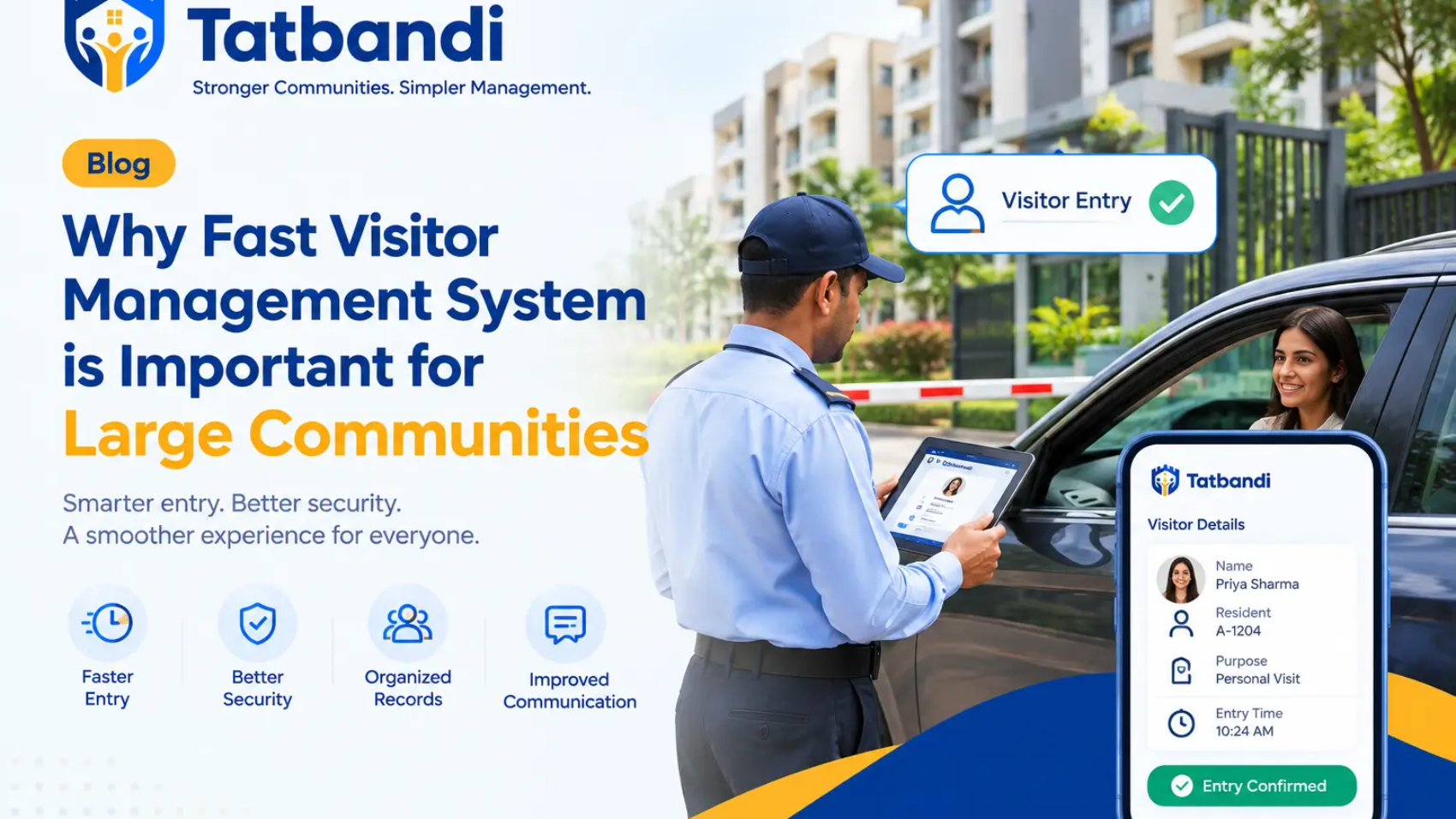
Smarter Visitor Management for Communities

Why a Fast Visitor Management System Is Important for Large Communities

Managing visitors in a large residential community is more than simply allowing guests through the main gate. When hundreds or thousands of residents, visitors, delivery partners, domestic workers, service providers, and vehicles enter and leave a society every day, traditional visitor registers can quickly become slow, difficult to maintain, and inefficient.

A fast visitor management system helps residential communities streamline entry, improve communication, maintain organized records, and create a smoother experience for residents, security staff, and visitors.

For large communities, speed is particularly important. A few extra minutes at the entrance can create long queues during busy hours. A digital approach can help security teams handle visitor information more systematically while giving residents better visibility over people entering their premises.

Tatbandi is a society management platform focused on simplifying everyday housing-society operations, including residents, maintenance, complaints, notices, expenses, parking, and other community activities. Its broader approach is built around reducing manual processes and keeping society management simple and organized.


What Is a Visitor Management System?

A visitor management system is a digital solution that helps residential communities manage and record visitors entering and leaving the premises.

Instead of depending entirely on a paper register at the security gate, a digital system can help organize visitor information and make the entry process more structured.

A visitor management system may be used for:

  • Guests visiting residents
  • Delivery personnel
  • Domestic workers
  • Maintenance workers
  • Contractors
  • Cab and taxi drivers
  • Service technicians
  • Vendors
  • Regular visitors
  • Event or community visitors

For a small residential building, a manual register may be manageable. For a large community with multiple towers, entrances, and hundreds of residents, a faster and more organized system becomes increasingly valuable.


Why Speed Matters in Large Residential Communities

Large communities experience significant visitor traffic during certain periods of the day.

Morning delivery schedules, office hours, school timings, evenings, weekends, and holidays can all create higher traffic at society entrances.

When every visitor requires lengthy manual verification, queues can quickly form at the gate.

A fast visitor management process can help security personnel handle visitors more efficiently while maintaining an appropriate verification process.

Faster Entry

Visitors can be processed more quickly when information is organized and readily available.

Less Congestion

Faster processing can help reduce unnecessary queues at the entrance.

Better Resident Experience

Residents and their guests spend less time waiting at the gate.

More Efficient Security Operations

Security personnel can spend less time dealing with paperwork and more time managing access and monitoring the entrance.


The Problems With Traditional Visitor Registers

Many societies still rely on paper registers to record visitor details.

Although simple, this approach can create several operational challenges as a community grows.

1. Manual Data Entry

Security guards need to repeatedly write visitor information into a register.

During busy periods, this can slow down the entry process.

2. Difficult Record Searching

Finding an old visitor entry in hundreds of handwritten pages can be time-consuming.

Digital records can make information easier to organize and retrieve.

3. Long Queues

When multiple visitors arrive simultaneously, manually recording every entry can result in delays.

4. Handwriting Issues

Visitor information written quickly may be difficult to read later.

5. Limited Visibility

A paper register generally stays at the security desk. Residents and committee members don’t have convenient digital visibility into the information.

6. Record Maintenance

Physical registers require storage and careful handling. Maintaining records over a long period can become inconvenient.


How a Fast Digital Visitor Management Process Helps

A well-designed digital visitor management process can make the entry experience more organized.

Instead of treating every visitor as a completely manual transaction, the system can structure the process around identification, verification, resident confirmation, entry recording, and exit tracking.

This creates a more consistent workflow for security personnel.


1. Faster Visitor Verification

Large communities may receive many visitors within a short period.

A digital visitor management system can help security personnel access relevant information quickly rather than searching through paper records.

This is particularly useful when regular visitors or service personnel frequently enter the community.

The objective is not simply to make entry faster but to make it faster while maintaining appropriate verification.


2. Reduced Queues at the Gate

A crowded entrance can create inconvenience for residents, visitors, delivery personnel, and security staff.

Imagine a community where several delivery agents arrive at the same time.

If every entry requires extensive manual writing and phone calls, the queue can quickly increase.

A faster digital process can help security personnel handle multiple visitors more systematically.

For large communities, even small improvements in processing time can make a noticeable difference during peak periods.


3. Better Resident Communication

Visitor management is closely connected to communication between security staff and residents.

When a visitor arrives for a particular flat, the resident may need to confirm whether the person should be allowed inside.

A connected society-management environment can make communication more structured than relying entirely on informal calls or messages.

Tatbandi’s broader product philosophy focuses on centralized resident communication, notices, complaints, parking information, and other society activities rather than scattered manual processes.


4. Improved Visitor Records

Digital records can provide a more organized history of visitor activity.

Depending on the implementation, records can include information such as:

  • Visitor name
  • Contact information
  • Resident being visited
  • Purpose of visit
  • Entry time
  • Exit time
  • Vehicle details
  • Visitor category

Having organized records can make it easier for authorized personnel to review visitor activity when necessary.


5. Better Management of Regular Visitors

Large communities often have people who visit regularly.

Examples include:

  • Domestic helpers
  • Drivers
  • Tutors
  • Fitness trainers
  • Caregivers
  • Maintenance professionals
  • Cleaning personnel
  • Delivery staff

Repeatedly processing the same person as a completely new visitor can create unnecessary work.

A structured digital visitor-management process can help communities handle recurring visitors more efficiently while still maintaining appropriate authorization and verification.


6. Smoother Delivery Management

Online shopping has significantly increased the number of delivery personnel entering residential communities.

Food delivery, grocery delivery, courier services, e-commerce packages, and other deliveries can create substantial traffic at society gates.

For large communities, delivery management can become a major responsibility for security teams.

A fast visitor management process can help security personnel distinguish between different types of visitors and handle them according to the society’s rules.

This can reduce confusion and improve gate operations.


7. Better Vehicle Management

Large societies may receive visitors arriving by:

  • Cars
  • Motorcycles
  • Scooters
  • Taxis
  • Auto-rickshaws
  • Commercial vehicles

Recording vehicle information digitally can make visitor and parking-related processes easier to organize.

Tatbandi already includes parking management and vehicle-based parking search as part of its society-management functionality.

This illustrates how visitor, resident, and parking information can be considered as connected parts of broader community management.


8. Reduced Workload for Security Staff

Security personnel are often the first point of contact for visitors.

If the process is complicated, guards have to spend significant time:

  • Writing information
  • Calling residents
  • Searching registers
  • Checking previous records
  • Answering visitor questions
  • Managing queues

A streamlined digital process can reduce repetitive administrative work.

This allows security personnel to focus more attention on the entrance, verification, and overall access process.


9. Better Experience for Residents

Residents may receive guests for a variety of reasons:

  • Family visits
  • Friends
  • Business meetings
  • Social gatherings
  • Home services
  • Repairs
  • Deliveries

A slow gate process can make visitors feel uncomfortable and create inconvenience for residents.

A faster system can make the overall experience smoother.

The goal is simple:

Visitors should be verified efficiently without creating unnecessary delays.


10. More Organized Community Management

Visitor management shouldn’t exist as an isolated process.

In a modern residential community, visitor information is connected to several other areas:

Residents → Visitors → Security → Parking → Complaints → Notices → Community Management

A centralized society-management platform can help committees move away from disconnected records and manual workflows.

Tatbandi follows this broader approach by bringing essential society activities such as residents, maintenance, expenses, notices, complaints, parking, and community participation into one workspace.


Visitor Management and Community Security

Speed should never mean removing necessary verification.

A fast visitor management system should aim for:

Speed + Verification + Visibility + Accountability

A system that allows anyone to enter without appropriate checks isn’t necessarily better simply because it is fast.

The objective should be to make legitimate visitor processing faster while maintaining the community’s access-control procedures.

For example, a society may establish different processes for:

  • Pre-approved guests
  • Regular domestic workers
  • Delivery personnel
  • Contractors
  • Service technicians
  • Unknown visitors
  • Emergency visitors

The exact rules should be determined by the society’s management committee and security policy.


Why Large Communities Need Digital Visitor Management More Than Small Societies

The difference becomes especially noticeable as community size increases.

Consider a residential complex with several hundred flats.

Even if only a small percentage of residents receive visitors at the same time, the entrance may experience dozens of visitor interactions within a short period.

With multiple buildings and entrances, manual management becomes increasingly difficult.

Small Community

Fewer residents → Fewer visitors → Lower traffic → Manual processes may remain manageable

Large Community

More residents → More visitors → Higher traffic → Greater need for structured digital processes

This is why scalability is an important consideration when selecting society-management technology.


What Should You Look for in a Visitor Management System?

Before implementing a solution, housing societies should evaluate several factors.

Easy to Use

Security personnel should be able to understand the process quickly.

Fast Processing

The system should minimize unnecessary steps at the entrance.

Resident Communication

The process should provide a practical way to communicate with the relevant resident when required.

Visitor Records

Authorized personnel should be able to access organized visitor information.

Vehicle Information

The system should accommodate vehicle-related requirements where applicable.

Privacy

Visitor information should be handled responsibly and only made available to authorized users.

Reliability

The system should work consistently during normal operating conditions and busy periods.

Integration

Ideally, visitor management should work alongside other society-management functions rather than creating another disconnected system.


How Tatbandi Fits Into Modern Society Management

Tatbandi is designed around the idea that society management should be simple rather than unnecessarily complicated.

Its current platform brings together essential functions such as:

  • Flats
  • Residents
  • Maintenance
  • Expenses
  • Penalties
  • Notices
  • Complaints
  • Parking
  • Polls
  • Community participation

The platform also supports web access and an Android application, with verified onboarding intended to ensure that society access is authorized rather than openly available to anyone.

For communities looking to modernize their everyday management processes, having related functions in one environment can help reduce dependence on multiple disconnected tools.


A Better Digital Experience for Large Communities

A modern residential community requires more than a digital payment system.

Residents interact with their society in many ways throughout the month.

They may:

  • Pay maintenance
  • Receive notices
  • Raise complaints
  • Check parking information
  • Participate in community activities
  • Receive guests
  • Contact the committee
  • Access society information

This means society-management software should focus on the complete resident experience, not just one administrative function.

Visitor management is one important part of that larger experience.


From Gate Management to Community Management

The future of residential management is moving toward connected digital experiences.

A visitor arrives at the gate.

A security guard verifies the visitor.

The resident confirms access where required.

The visitor enters.

Vehicle information can be recorded when necessary.

The entry is stored digitally.

This type of structured workflow can reduce unnecessary manual work while creating better visibility for authorized users.

When connected with resident, parking, notice, complaint, and maintenance systems, it becomes part of a broader digital community-management ecosystem.


Benefits at a Glance

Traditional Process Fast Digital Process
Paper registers Organized digital records
Manual searching Faster information access
Repeated writing Structured data entry
Long queues Faster processing
Scattered communication More organized communication
Difficult historical tracking Easier record review
Manual vehicle records Structured vehicle information
More administrative work Streamlined workflows

Frequently Asked Questions

Why is visitor management important for large housing societies?

Large communities receive significant visitor traffic every day. A structured visitor management process can help reduce queues, organize visitor information, improve communication, and make gate operations more efficient.

Is visitor management only about security?

No. Visitor management can also improve resident experience, reduce administrative workload, organize visitor records, and streamline delivery and service-person entry.

Can visitor management reduce waiting time?

A well-designed digital process can reduce unnecessary manual steps and help security personnel process visitors more efficiently. Actual time savings depend on the system, visitor volume, society policies, and implementation.

What types of visitors can be managed?

Depending on the system and society policies, visitor management can cover guests, delivery personnel, domestic workers, drivers, contractors, technicians, vendors, and other visitors.

Should visitor management be connected with society management software?

For many communities, integration can be useful because visitor activity is connected to residents, vehicles, parking, communication, and other society operations.


Conclusion

For large residential communities, visitor management is no longer just about maintaining a register at the security gate.

High visitor volumes, delivery traffic, service personnel, guests, and multiple residential buildings can make traditional processes increasingly difficult to manage.

A fast visitor management system can help communities create a more organized process for verification, communication, record keeping, and entry management.

However, speed should always work together with appropriate verification and privacy.

The broader goal is to create a residential environment where technology removes unnecessary administrative work while helping residents, committees, and security teams work more efficiently.

Tatbandi takes this practical approach to society management by bringing essential community functions into a simple digital platform. Its current feature set includes residents, maintenance, expenses, notices, complaints, parking, and community participation, with web and Android access and verified onboarding. 

As residential communities continue to grow, moving from scattered manual processes toward organized digital management can help create a smoother experience for everyone.

Tatbandi — Society Management Made Simple

Manage better. Communicate clearly. Build more connected communities.

Tatbandi Society Management Made Simple

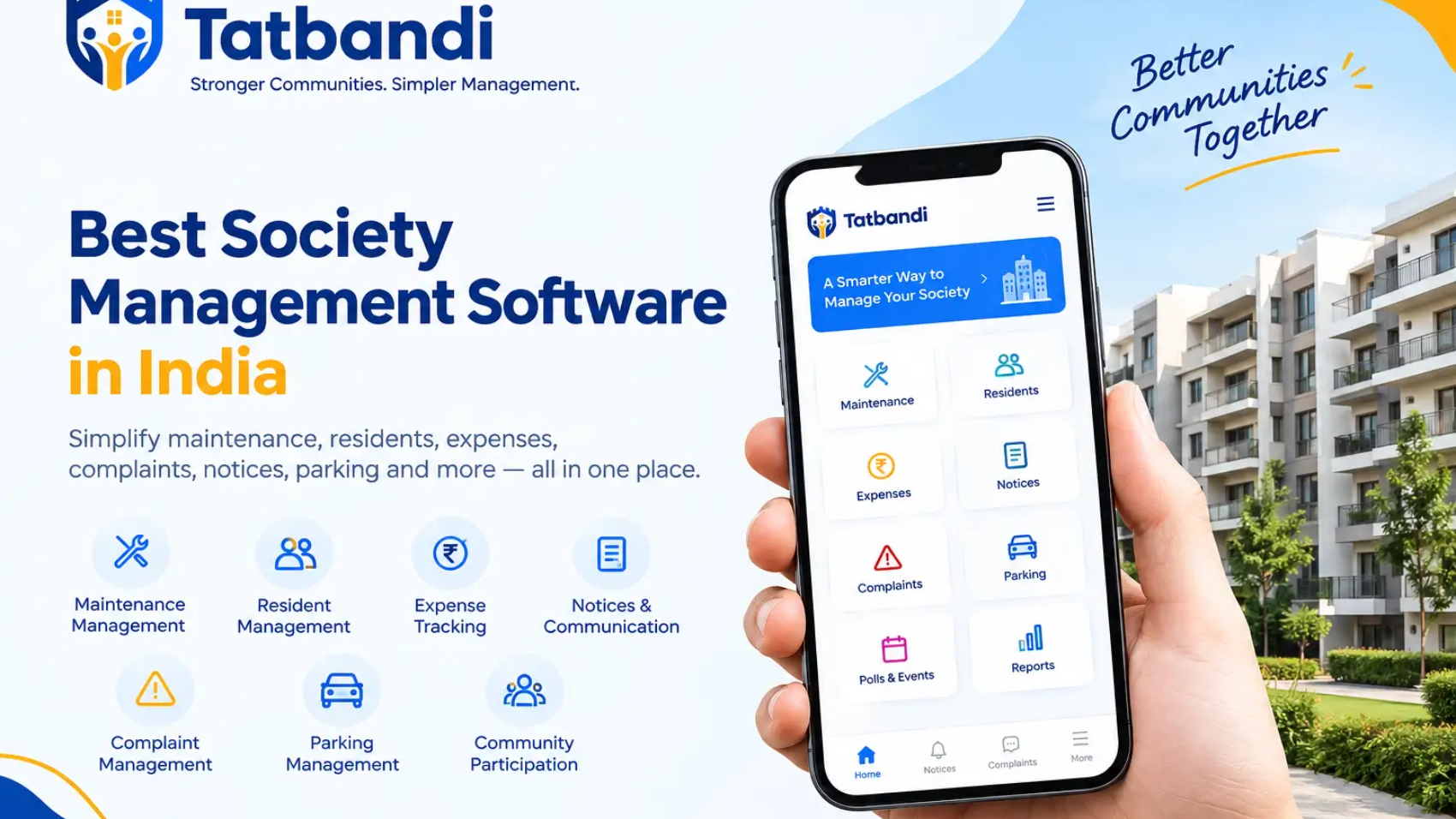
Best Society Management Software in India: A Complete Guide for Housing Societies

Managing a housing society involves much more than collecting monthly maintenance. Society committees have to maintain resident records, track payments, manage expenses, handle complaints, circulate notices, organize parking information, and keep residents informed.

When these activities are handled through spreadsheets, paper records, phone calls, and multiple messaging groups, everyday management can become time-consuming and difficult to track.

This is where society management software can help.

Among the solutions available for Indian housing societies, Tatbandi is designed to simplify essential society operations through a centralized digital platform. It focuses on practical day-to-day requirements such as maintenance, residents, expenses, complaints, notices, parking, and community participation. Tatbandi


What Is Society Management Software?

Society management software is a digital platform that helps residential communities manage their administrative and operational activities from one place.

Instead of maintaining separate Excel files for residents, using WhatsApp for notices, keeping payment information in different records, and manually tracking complaints, a society can use a centralized platform.

Depending on the software, features can include:

  • Resident and flat management
  • Maintenance billing
  • Payment tracking
  • Expense management
  • Complaint management
  • Society notices
  • Parking management
  • Polls and elections
  • Reports
  • Data backup and export
  • Web and mobile access

The objective is not simply to digitize existing paperwork. A good platform should make society management simpler, more organized, and more transparent.


Why Do Housing Societies Need Management Software?

Traditional society management often depends on a combination of spreadsheets, registers, WhatsApp groups, payment screenshots, and manual follow-ups.

While these methods can work for smaller communities, they can become difficult to manage as the number of flats and residents increases.

1. Better Maintenance Tracking

Monthly maintenance is one of the most important recurring activities for a housing society.

A digital system can help committees generate and publish maintenance bills, track outstanding dues, and maintain payment records.

Tatbandi supports maintenance billing and allows authorized committee members to verify payments and mark bills as paid. Societies can also use their existing payment methods such as UPI, bank transfers, cash, or cheques. Tatbandi

2. Centralized Resident Information

Maintaining resident and flat information in multiple spreadsheets can make it difficult to find updated information.

A centralized platform gives authorized committee members a structured way to manage flats and residents.

Tatbandi also supports CSV import, which can help societies that already maintain their information in spreadsheet format. Tatbandi

3. Easier Communication

Important society information can easily get buried in WhatsApp conversations.

A dedicated notice system gives committees a central place to publish announcements so residents can find important information more easily.

4. Complaint Tracking

Complaints are a regular part of society management.

Instead of depending entirely on messages or verbal communication, residents can raise complaints digitally while committee members can track and respond to them systematically.

5. Expense Management

Societies need to maintain records of expenses related to maintenance, repairs, services, utilities, and other activities.

Digital expense tracking can make records easier to organize and review.

Tatbandi allows committees to record expenses with categories, notes, and dates. Tatbandi


What Makes a Good Society Management Software?

Before selecting software for your housing society, committees should consider more than the number of features.

A useful platform should offer:

Ease of Use

Residents should be able to check information without extensive training.

Transparent Records

Maintenance, expenses, bills, notices, and complaints should be organized clearly.

Data Control

The society should be able to retain access to its own information.

Privacy

Housing societies manage personal and administrative information, so access controls and responsible onboarding are important.

Flexible Access

Both committee members and residents should have convenient ways to access the platform.

Practical Features

The software should solve actual society-management problems rather than adding unnecessary complexity.


Tatbandi: Society Management Made Simple

Tatbandi is a society management platform designed specifically around practical housing society requirements.

Instead of trying to overwhelm committees with complicated enterprise software, Tatbandi focuses on the core activities societies deal with every day.

Its platform brings together:

  • Flats and residents
  • Maintenance
  • Expenses
  • Penalties
  • Notices
  • Complaints
  • Parking
  • Polls
  • Community participation
  • Reports

This creates a centralized workspace for committees and a simpler information-access experience for residents. Tatbandi


Key Features of Tatbandi

1. Maintenance Management

Maintenance collection is a major responsibility for every housing society.

Tatbandi helps committees create and publish maintenance bills, track dues, verify payments, and maintain payment records.

The platform supports both traditional payment workflows and optional online payment collection. For manual collection, residents can pay the society directly using methods such as UPI, bank transfer, cash, or cheque, while the committee verifies and records the payment in Tatbandi. Tatbandi


2. Resident & Flat Management

Keeping resident and flat information organized helps committees handle everyday administration more efficiently.

Tatbandi provides tools for managing flats and residents and supports CSV import for faster onboarding when information is already available in a spreadsheet. Tatbandi


3. Expense Tracking

Society expenses should be properly recorded and organized.

Tatbandi allows committee members to record expenses using categories, notes, and dates, providing a structured way to maintain financial records. Tatbandi


4. Notices & Announcements

Important announcements shouldn’t get lost among everyday messages.

Tatbandi provides a dedicated notice functionality where committees can publish information for residents.

This can make communication more organized and reduce dependence on scattered messages.


5. Complaint Management

Maintenance issues, facility problems, and other resident concerns need proper follow-up.

With Tatbandi, residents can raise complaints digitally and committees can track them more systematically. Tatbandi


6. Parking Management

Parking can become complicated in residential societies, particularly when residents need to identify vehicles or verify parking allocations.

Tatbandi includes parking management functionality, including vehicle-based parking search capabilities. Tatbandi


7. Polls and Community Participation

Society decisions often require resident participation.

Tatbandi includes features for polls and community participation, helping societies move certain activities into a structured digital environment. Tatbandi


Tatbandi for Society Committees

Committee members have multiple responsibilities, and society management software should reduce administrative workload rather than add to it.

Tatbandi gives committees a centralized environment for managing:

Maintenance → Residents → Expenses → Notices → Complaints → Parking → Community Activities

The platform is designed to keep committee members in control of what information is published and how society records are managed. Tatbandi


Tatbandi for Residents

A society management system is only useful if residents can use it easily.

Tatbandi provides residents with access to relevant society information, including published dues, notices, complaint updates, and parking-related information.

Residents can access Tatbandi through the browser, while an Android app is also available with OTP-based login. Tatbandi

The focus is on allowing residents to quickly:

  • Check their dues
  • View notices
  • Follow complaint updates
  • Access parking information
  • Stay informed about society activities

Privacy and Verified Access

Privacy is particularly important when software is being used to manage housing society information.

Tatbandi uses a verified onboarding model rather than unrestricted open self-registration. Society authorization and consent are checked before access is provided. Tatbandi

The platform also states that residents do not need unnecessary device permissions for normal use.

This approach is intended to give society committees greater control over who receives access to their community’s information.


Keep Your Society Data Accessible

One important consideration when selecting society management software is data ownership and portability.

A society should not feel locked into a platform.

Tatbandi supports CSV export, allowing societies to retain access to their records and maintain a backup of their data. Tatbandi

This is particularly useful when committees change or when a society needs to review or maintain its records independently.


Simple Pricing for Housing Societies

Tatbandi follows a straightforward per-flat subscription model.

According to its current pricing information, Tatbandi offers a single plan at ₹11 per flat per month, or ₹132 per flat per year, with the same core features across the billing cycles. Eligible housing societies can also receive a 3-month free trial. Tatbandi

The software subscription is separate from maintenance collection.

For societies using manual payment collection, Tatbandi states that there is no platform fee for marking payments as paid. An optional integrated online payment gateway carries a stated 1% Tatbandi platform fee on online maintenance payments, in addition to applicable gateway charges. Tatbandi

Because pricing and payment policies can change, societies should confirm the current terms with Tatbandi before subscribing.


How to Choose the Right Society Management Software in India

Every housing society has different requirements. Before selecting a platform, the committee should evaluate the following:

1. Identify Your Main Problems

Are you struggling with maintenance tracking, complaints, notices, resident records, expenses, or parking?

Start with the problems that consume the most administrative time.

2. Check the Essential Features

Make sure the software includes the functions your society actually needs.

3. Consider Resident Experience

A complicated system may discourage residents from using it.

4. Understand Payment Processes

Check whether the platform supports your preferred payment methods and understand any transaction-related charges.

5. Review Data Policies

Ask how your society’s information is stored, accessed, exported, and backed up.

6. Check Onboarding

A simple onboarding process can make implementation much easier.

7. Try Before You Commit

A demo or trial can help committee members and residents understand whether the platform works for their community.


Why Tatbandi Can Be a Practical Choice for Small Housing Societies

Not every society needs a complicated enterprise management system.

Smaller housing societies may prefer software that concentrates on the essentials without requiring extensive training or complex implementation.

Tatbandi is specifically positioned around small housing societies that want transparent maintenance tracking, resident communication, and straightforward day-to-day operations without unnecessary complexity. Tatbandi

Its approach combines core management features with web and Android access, verified onboarding, CSV import/export, and a simple per-flat pricing model. Tatbandi


Moving From Manual Management to Digital Society Management

Digital transformation doesn’t mean every society process has to change overnight.

A practical transition can begin with a few important areas:

Step 1: Organize flat and resident information
Step 2: Start digital maintenance records
Step 3: Centralize notices
Step 4: Introduce digital complaint tracking
Step 5: Record society expenses systematically
Step 6: Organize parking information
Step 7: Gradually move additional community activities online

With this approach, committees can introduce technology without unnecessarily disrupting existing processes.


Frequently Asked Questions

What is the best society management software in India?

The right software depends on the size of the society, required features, budget, resident adoption, and committee requirements. Tatbandi is a society management platform focused on practical day-to-day operations such as maintenance, residents, expenses, complaints, notices, parking, and community participation. Tatbandi

Is Tatbandi suitable for small housing societies?

Yes. Tatbandi specifically positions itself for small housing societies that want essential management functionality without unnecessary complexity. Tatbandi

Can residents use Tatbandi on mobile?

Yes. Tatbandi provides an Android app as well as browser-based access. Residents can use OTP login through the Android application. Tatbandi

Can society committees manage maintenance through Tatbandi?

Yes. Tatbandi supports maintenance billing, payment verification, and payment-status management. Tatbandi

Does Tatbandi support complaints?

Yes. Residents can raise complaints digitally, while committees can track and respond to them. Tatbandi

Can a society export its data?

Yes. Tatbandi supports CSV export so societies can retain access to their records. Tatbandi

How much does Tatbandi cost?

Tatbandi currently lists pricing at ₹11 per flat per month or ₹132 per flat per year, with eligible societies receiving a 3-month free trial. Current pricing should be confirmed before purchase. Tatbandi


Conclusion

Managing a housing society involves dozens of small administrative activities every month. When these activities are spread across spreadsheets, registers, messaging apps, and manual follow-ups, maintaining accurate records and clear communication can become challenging.

Society management software brings these activities together into a centralized digital system.

Tatbandi focuses on the practical requirements of Indian housing societies — from maintenance and resident management to expenses, notices, complaints, parking, and community participation.

With simple workflows, verified onboarding, web and Android access, CSV data support, and a straightforward per-flat pricing model, Tatbandi provides a digital approach to everyday society management. Tatbandi

For housing societies looking to reduce manual administration and create a more organized way of managing everyday operations, Tatbandi offers a platform built around one simple idea: society management should feel simple.

Make Society Management Simpler with Tatbandi

Manage better. Communicate clearly. Stay organized.